
WhatsApp Authentication: The 2026 Standard for User Verification
Here's a number most founders never look at: how **** revenue quietly disappears every month because an OTP simply never arrived. Not a failed payment, not cart abandonment in the usual sense — just a boring, invisible delivery failure.
A user signs up, enters their number, and waits. The SMS takes 40 seconds instead of 5, or it never shows up at all. They refresh, try again, maybe hit resend, and eventually just close the tab. On your dashboard, this doesn't register as "OTP failed." It shows up as "incomplete registration" — the real cause buried somewhere in the funnel.
This is exactly why WhatsApp Authentication has moved from "nice-to-have" to something closer to a revenue protection strategy in 2026.
What Is WhatsApp Authentication?
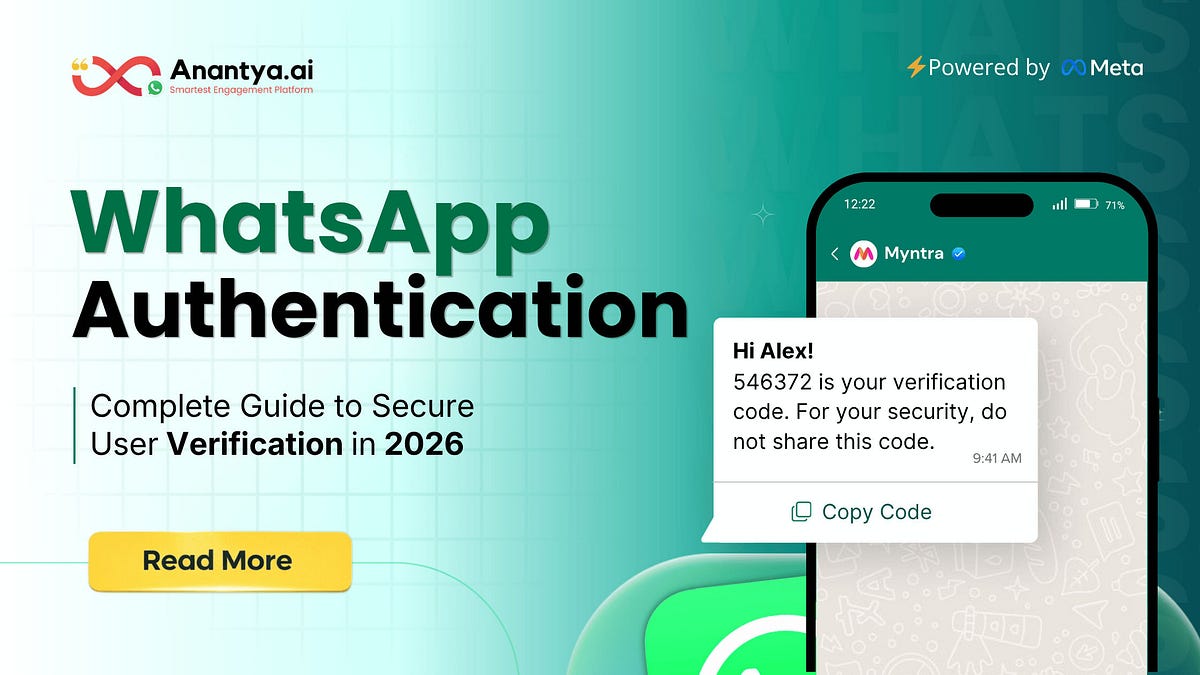
At its core, WhatsApp Authentication is a way of verifying a user's identity by sending a one-time password (or similar verification prompt) through WhatsApp instead of traditional SMS. It runs on the WhatsApp Business API, which sends pre-approved, structured message templates directly to a user's WhatsApp number.
This isn't limited to plain OTPs either. The same infrastructure powers login verification, transaction approvals, account recovery, two-factor authentication, and flagging logins from unfamiliar devices.
How the Verification Flow Actually Works
Users enter their phone number on a signup, login, or checkout screen.
The backend calls the WhatsApp OTP API, usually through a Business Solution Provider (BSP), specifying the approved template and generating a time-bound code.
A well-built system also includes an automatic SMS fallback: if the WhatsApp message doesn't deliver or isn't opened within a set window, the system quietly switches to SMS so no user gets stuck.
Why Businesses Are Making the Switch
A handful of numbers explain most of this shift. WhatsApp messages see open rates around 98%, compared to 85-90% for SMS and barely 25-30% for email. More importantly, they're typically opened within 90 seconds — which matters a lot when your OTP has a 10-minute expiry window.
There's also a trust dimension that's easy to underestimate. A verified, branded WhatsApp message feels fundamentally different from an SMS sent from a random alphanumeric sender ID — something users have learned to be wary of. And because WhatsApp OTPs are tied to a device-level account rather than just a SIM card, they're harder to intercept through SIM-swap or SS7-style attacks, which meaningfully lowers fraud exposure compared to SMS.
Summary
This guide walked through what WhatsApp Authentication actually is, how the verification flow works end to end, and why delivery speed, open rates, and trust make it a meaningfully stronger option than SMS OTP for most businesses. We compared the two side by side, looked at where WhatsApp Authentication is already proving valuable — e-commerce, fintech, healthcare, EdTech, SaaS, travel, and logistics — and covered the common challenges (delivery failures, non-WhatsApp users, integration complexity, compliance) along with practical fixes for each.
For more information kindly read the full blog - https://aaftabalfa.medium.com/whatsapp-authentication-the-2026-standard-for-user-verification-01e154ba8d0f?sharedUserId=aaftabalfa

 English
 Arabic
 Spanish
 Portuguese
 Deutsch
 Turkish
 Dutch
Dutch
 Italiano
 Russian
 Romaian
 Portuguese (Brazil)
 Greek
Greek